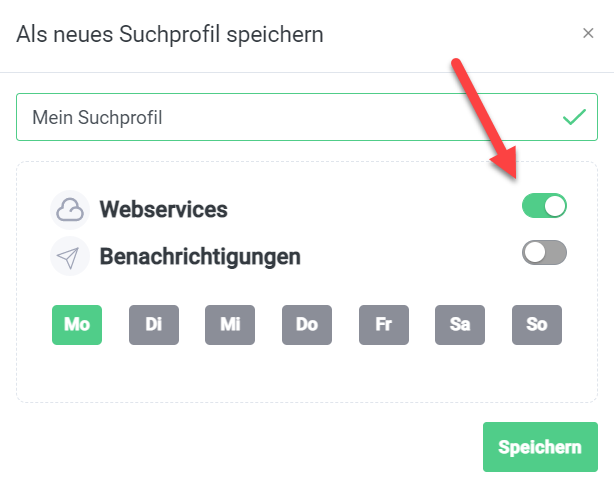
To be able to use the web service, you first need to set up a search profile. When saving the search profile, make sure that it is created with the "Web Service" option:
This applies equally to search profiles of the type Projects and of the type Submissions — create a separate search profile for each object type.
The ID of the search profile can be obtained from its URL, as shown in below example:
To connect to the web service, you must first log in. This can be reached via the endpoint POST /login_check. Here, a request is made using the username and password of the provided user. The login is identical — regardless of whether you subsequently retrieve projects or submissions.
Example login query:
Example login result:
A successful access provides a JWT token and a refresh token. The former is required for any further contact with the interface. The latter is required to obtain a new token after the expiration of the current token.
Important
If you have a standard user who cannot log in multiple times simultaneously, you will also receive a security cookie. You must include this cookie with every request as well.
Session management note
When testing the interface, please note that only one active session per user account is allowed. If you log in via the interface using a username and password, any existing browser session will be automatically terminated. The same applies in reverse: once you log in again in the browser, the existing API session will be terminated. This should be taken into account especially during development and testing activities.
Example
The JWT is valid for one hour by default. If a longer session is needed, then the token can be renewed using the refresh token under POST /token/refresh as follows:
Example Refresh Query:
This query result is identical to the login query. Also, the refresh token is valid for 8 hours and is renewed with each call.
Fetching the data
There are two possible endpoints corresponding to the products available in Xplorer.
Note
SearchProfile IDs are strictly tied to their respective endpoint (object type) and cannot be reused across different endpoints. If a SearchProfile is used with a mismatched endpoint, it will result in a "SearchProfile with given id not found" error, even if the ID itself exists.
Endpoint name
Objects
all_pn_headers
Calls for Tenders / Tenders
projects
Projects
Note
The objects available to you depend on your Baublatt framework agreement.
The data retrieval process takes place via one of the above-mentioned endpoints using the GET method, for example /web_service/all_pn_headers/. Bearing this in mind, the previously obtained JWT token and the ID of the previously created search profile are required. The token is passed using the Authorization header, and the search profile ID is provided using a GET parameter as follows:
Example Data RetrievalProjects
Example Data RetrievalSubmissions
If available, this query now provides the new information of your search profile. The record format can be selected by using the “Accept header” as shown below:
Accept: application/xml
Accept: application/json
Accept: application/ld+json
Recommendation
For new integrations, we recommend using the application/json format, as this format is natively supported in most programming languages and integration platforms.
Confirmation of Pickup
The web service provides records of your search profile and remembers previous record retrieves. By default, 10 or 20 records (Projects or Tenders) per call are provided from the above-mentioned endpoints. Two ways are available to retrieve the next 20 records as explained below:
Confirmation via Header
If you do not want to call another endpoint, data retrieval can be confirmed by using the X-AUTO-ACK header as shown below:
Example Pickup with Auto-Ack:
Confirmation via endpoint
The next 20 records can be retrieved by using the endpoint POST /web_service/acknowledge/. Search profile ID and the IDs of confirmed records are required in the JSON object as shown below. This method minimizes the risk of losing records in the retrieval process.
Example endpoint:
Data Structure
Select below which data structure you want to view.
Projects/web_service/projects/
Submissions/web_service/all_pn_headers/
Note: Whenever you see a data field labeled "Code" in the data structure, you can download a corresponding list of all available codes along with their associated names as a CSV file using the download icon .
Projects · /web_service/projects/
Field
Type
Description
Example
externalID
string
External ID
3197834
id
int
Unique ID
312885
title
string
Title
Neubau Reservoir mit Leitungsersatz
subtitle
Not used for CH
postcode
int
Postal code
4001
country
string
Country
CHE
town
string
City
Basel
area
string
Area designation
Zwischen der Bahnhofstrasse und der Strasse «Im Sack»
street
string
Street name and house number
Reservoir Häuslersegg
projectValue
double
Construction cost in currency units
1340000
valueDescription
string
Construction cost text
1.34 Mio CHF
startDate
datetime
Construction start
2023-05-21T22:00:00+00:00
startDateAccuracy
Not used for CH
startDescription
string
Text for the construction start
Mai 2023
endDate
datetime
Construction end
2024-06-29T22:00:00+00:00
endDescription
string
Text for the construction end
Juni 2024
lastPublished
datetime
Last published
2023-05-23T09:13:44+00:00
lastUpdate
datetime
Last update
2023-05-23T09:13:44+00:00
projectTexts
Field
Type
Description
Example
content
string
Text content
Bewerbung erst nach Veröffentlichung der Ausschreibung möglich
projectTextType
Field
Type
Description
Example
code
string
Code
500
name
string
Name
Gewerkebemerkung
sortOrder
int
Sorting
1
projectDetails
Field
Type
Description
Example
id
int
Unique ID
32502749
value
string
Value
15
negated
boolean
Type negated: Yes/No
0
unitType
Not used for CH
projectDetailType
Field
Type
Description
Example
id
int
Unique ID
763
code
string
Code
CH_STRUCTURES
name
string
Name
Fenster
sortOrder
int
Sorting
1
visible
boolean
Type visible: Yes/No
0
parentProjectDetailType
Field
Type
Description
Example
id
int
Unique ID
5
code
string
Code
Bestandteil
name
string
Name
Bestandteile
sortOrder
int
Sorting
1
visible
boolean
Type visible: Yes/No
0
projectDisplayGroup
Field
Type
Description
Example
id
int
Unique ID
3
code
string
Code
COST_SIZE
filterable
boolean
Type filterable: Yes/No
1
investmentType
Not used for CH
qualityType
Not used for CH
labelProjects
Not used for CH
projectType
Field
Type
Description
Example
id
int
Unique ID
33
code
string
Code
50
name
string
Name
Technische Anlagen
sortOrder
int
Sorting
50
projectResearchType
Field
Type
Description
Example
id
int
Unique ID
8
code
string
Code
1
infoText
string
Research type
Achtung: Dieses Projekt wird aufgrund des schnellen Baufortschritts nicht aktualisiert.